
Eastern Air Lines Flight 401 (December 29, 1972)
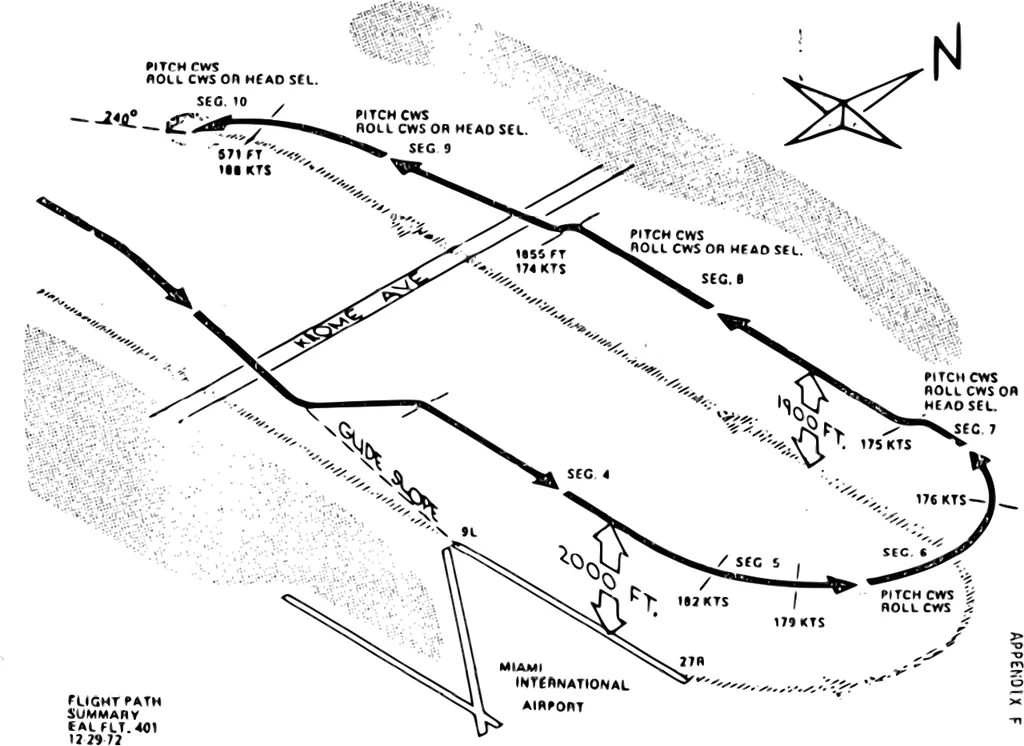
A Lockheed L-1011, N310EA, crashed in the Florida Everglades 18.7 miles west-northwest of Miami International Airport. The NTSB report states that, of the 163 passengers and 13 crewmembers aboard, “94 passengers and 5 crewmembers received fatal injuries. Two survivors died later as a result of their injuries.” According to the report, after a missed approach for a suspected nose gear malfunction, the three flight crewmembers and a jumpseat occupant “became engrossed in the malfunction.”
The NTSB determined the probable cause to be “the failure of the flight crew to monitor the flight instruments during the final 4 minutes of flight, and to detect an unexpected descent soon enough to prevent impact with the ground. Preoccupation with a malfunction of the nose landing gear position indicating system distracted the crew’s attention from the instruments and allowed the descent to go unnoticed.”
United Airlines Flight 173 (December 28, 1978)
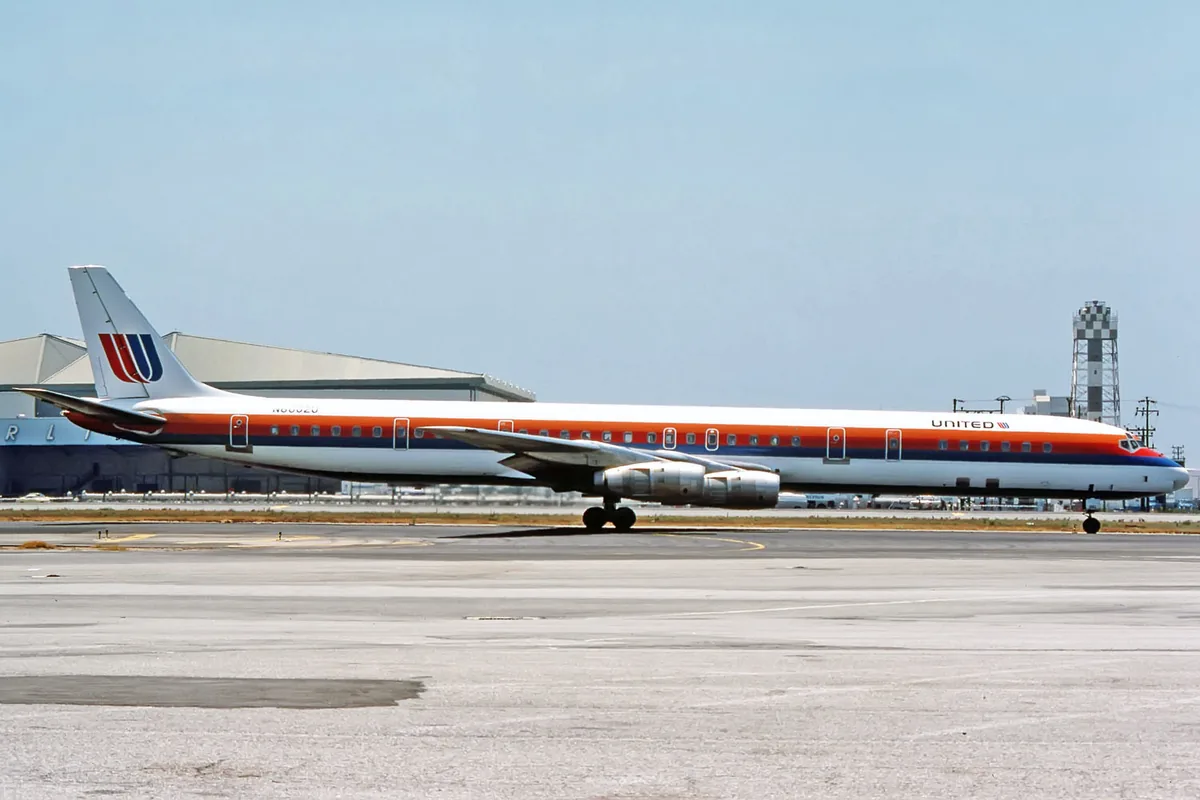
A McDonnell Douglas DC-8-61, N8082U, held southeast of Portland International Airport “for about 1 hour while the flightcrew coped with a landing gear malfunction,” according to the NTSB. It then crashed about 6 nautical miles southeast of the airport after fuel exhaustion. Ten of the 189 people aboard were killed: 8 passengers, the flight engineer, and a flight attendant.
The NTSB’s probable cause centered on fuel-state monitoring: “the failure of the captain to monitor properly the aircraft’s fuel state and to properly respond to the low fuel state and the crewmember’s advisories regarding fuel state. This resulted in fuel exhaustion to all engines.” The Board listed as contributing “the failure of the other two flight crewmembers either to fully comprehend the criticality of the fuel state or to successfully communicate their concern to the captain.”
The Board recommended (X-79-17) that the FAA direct its air carrier operations inspectors to urge their assigned operators “to ensure that their flightcrews are indoctrinated in principles of flightdeck resource management, with particular emphasis on the merits of participative management for captains and assertiveness training for other cockpit crewmembers.”
How the FAA defines it
- FAA Advisory Circular 120-51E: CRM “refers to the effective use of all available resources: human resources, hardware, and information.”
- The AC states that CRM training “focuses on situation awareness, communication skills, teamwork, task allocation, and decisionmaking within a comprehensive framework of standard operating procedures (SOP).”
- 14 C.F.R. § 121.404 provides: “No certificate holder may use a person as a flightcrew member, flight attendant, or aircraft dispatcher unless that person has completed approved crew resource management (CRM) or dispatcher resource management (DRM) initial training, as applicable, with that certificate holder or with another certificate holder.”
How Naval Aviation frames it
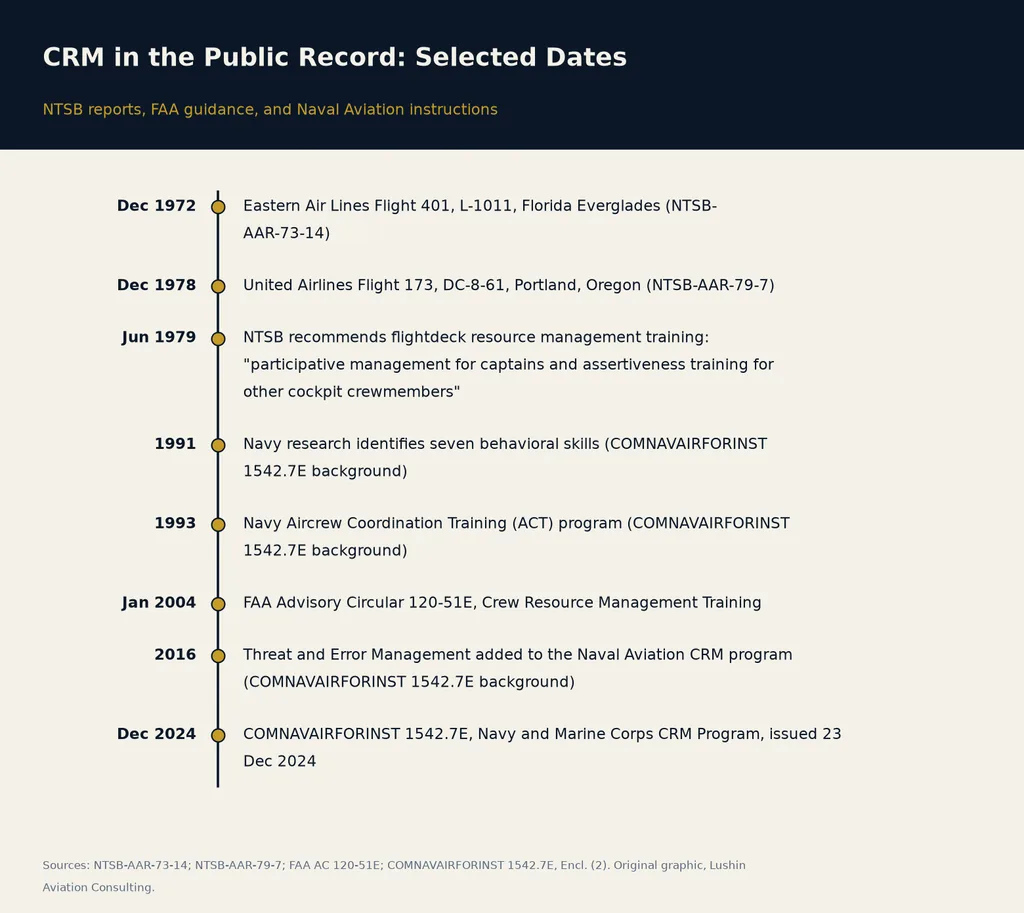
The Navy and Marine Corps CRM program (COMNAVAIRFORINST 1542.7E, December 23, 2024) defines CRM as “the effective use of all available resources by individuals, aircrews, and teams to safely and efficiently accomplish a mission or task. CRM also identifies and manages conditions leading to error.” The instruction’s background states that Navy research in 1991 identified seven behavioral skills, that the Aircrew Coordination Training program followed in 1993, and that Threat and Error Management was added in 2016.
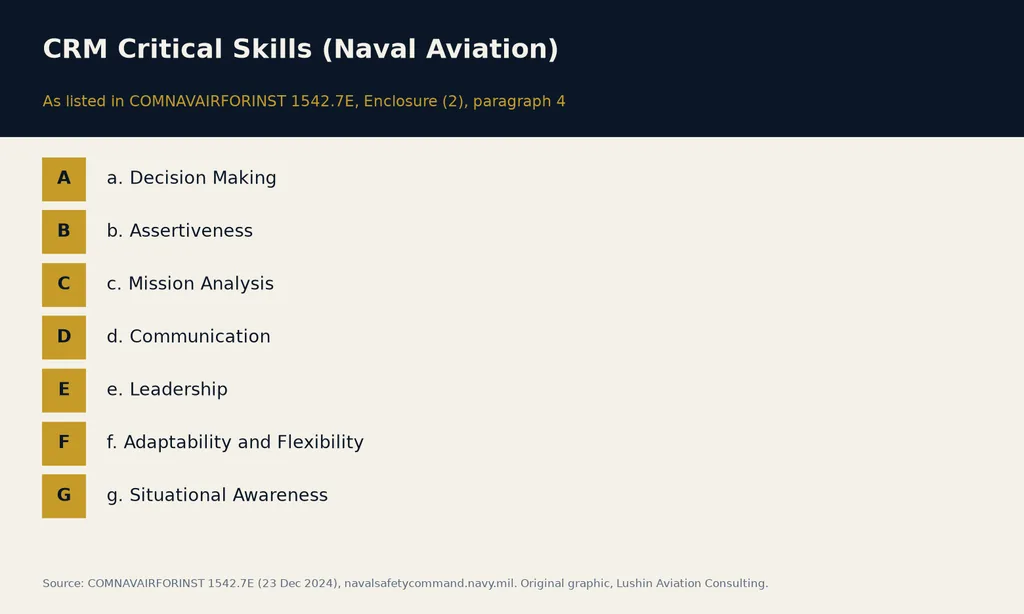
The program is built on seven critical skills, often remembered as DAMCLAS:
- Decision Making
- Assertiveness
- Mission Analysis
- Communication
- Leadership
- Adaptability and Flexibility
- Situational Awareness
CRM in the public record: selected dates
Weeks 2 through 8 take one skill per week, in the order the instruction lists them, each anchored in a closed NTSB or military report. Next week: Decision Making.
View the Week 1 post on LinkedIn →
Sources
- NTSB, Aircraft Accident Report NTSB-AAR-73-14, Eastern Air Lines, Inc., L-1011, N310EA, Miami, Florida, December 29, 1972. NTSB (PDF)
- NTSB, Aircraft Accident Report NTSB-AAR-79-7, United Airlines, Inc., McDonnell-Douglas DC-8-61, N8082U, Portland, Oregon, December 28, 1978. NTSB (PDF)
- FAA, Advisory Circular 120-51E, Crew Resource Management Training (January 22, 2004). FAA (PDF)
- 14 C.F.R. § 121.404, Crew and dispatcher resource management training. eCFR
- Commander, Naval Air Forces, COMNAVAIRFORINST 1542.7E, Navy and Marine Corps Crew Resource Management Program (December 23, 2024), Enclosure (2). Naval Safety Command (PDF)