
How official sources define it
COMNAVAIRFORINST 1542.7E, Enclosure (2), defines Assertiveness as “an individual’s willingness to actively participate, state, and maintain a position, until convinced by the facts that other options are better. Assertiveness is respectful and professional, used to resolve problems appropriately, and to improve mission effectiveness and safety.”
FAA Advisory Circular 120-51E, Appendix 1, under “Inquiry/Advocacy/Assertion,” lists this behavioral marker: “Crewmembers speak up and state their information with appropriate persistence until there is some clear resolution.”
United Airlines Flight 173 (December 28, 1978)
The DC-8-61 crashed near Portland, Oregon, after fuel exhaustion to all engines (see Week 1). In its analysis (p. 27), the NTSB wrote that the first officer “did, in fact, make several subtle comments questioning or discussing the aircraft’s fuel state,” and that before the No. 4 engine flamed out, “the comments were not given in a positive or direct tone.” The Board listed as contributing to the accident “the failure of the other two flight crewmembers either to fully comprehend the criticality of the fuel state or to successfully communicate their concern to the captain.” The same page states that “assertiveness training should be a part of the standard curricula, including the need for individual initiative and effective expression of concern.”
Air Florida Flight 90 (January 13, 1982)
During the takeoff roll at Washington National Airport, the CVR recorded the first officer stating “that don’t seem right, does it?” and “Naw, I don’t think that’s right,” followed later by “...maybe it is” and “I don’t know” (see Week 2). On p. 68 of its report, the NTSB wrote: “while he clearly expressed his view that something was not right during the takeoff roll, his comments were not assertive. Had he been more assertive in stating his opinion that the takeoff should be rejected, the captain might have been prompted to take positive action.”
Air Illinois Flight 710 (October 11, 1983)
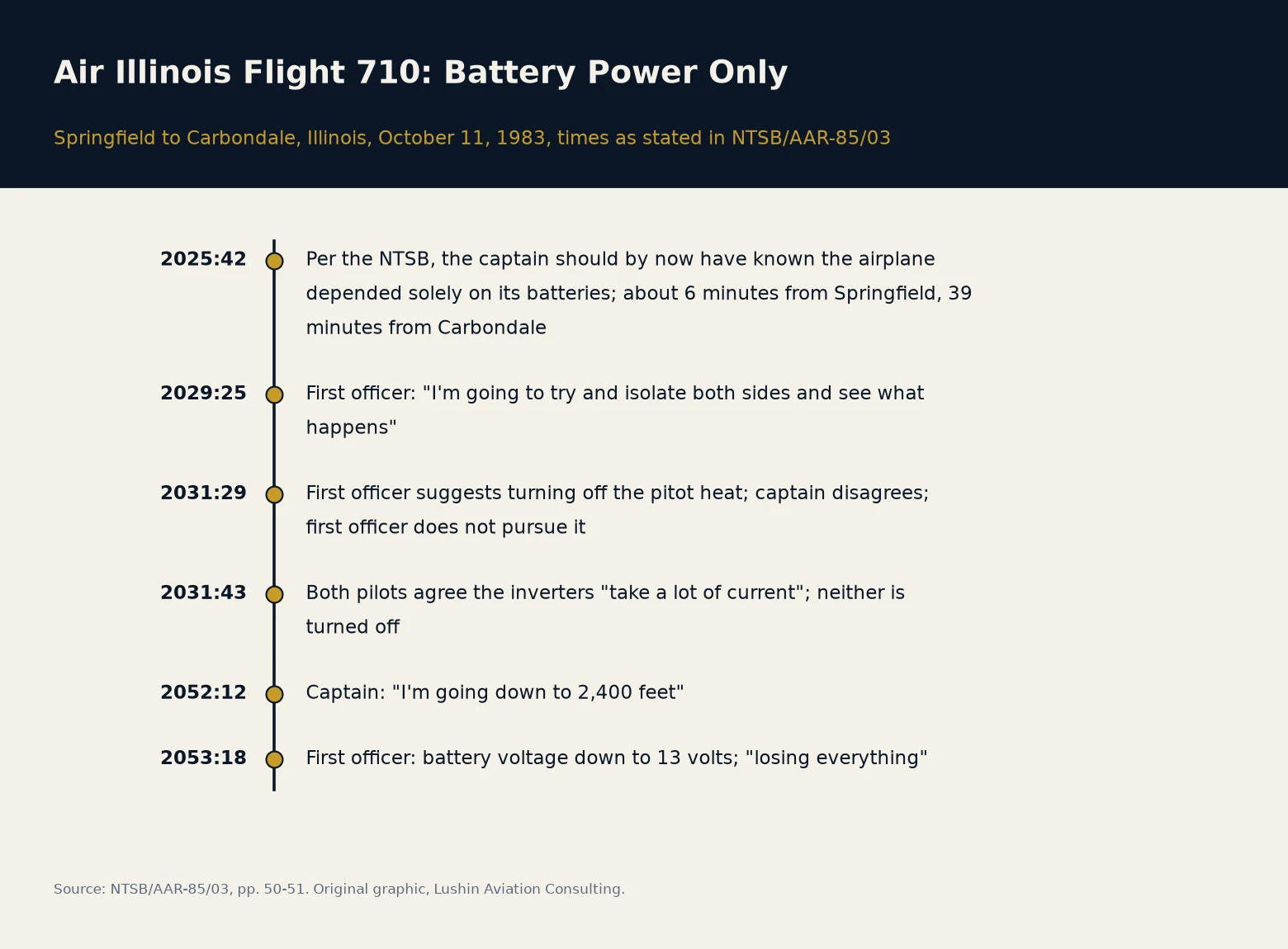
A Hawker Siddeley HS 748-2A, N748LL, crashed near Pinckneyville, Illinois, on a night flight from Springfield to Carbondale; all 10 people aboard were killed. The NTSB reported that both generators had failed shortly after takeoff and that the airplane continued on battery power alone. According to NTSB report AAR-85/03 (times as stated in the report):
- 2025:42: According to the NTSB (p. 51), the captain should by then have known that the airplane depended “solely on its batteries for electrical power,” about 6 minutes from Springfield and 39 minutes from Carbondale. He continued toward Carbondale.
- 2029:25: The first officer said, “I’m going to try and isolate both sides and see what happens.” When the captain explained why he did not want this done, the NTSB wrote, “the first officer did not point out to the captain that the actions were required by the emergency procedure checklist” (p. 50).
- 2031:29: The first officer suggested turning off the pitot heat; “the captain disagreed and the first officer did not pursue the subject” (p. 50).
- 2052:12: The captain said, “I’m going down to 2,400 feet” (p. 51).
- 2053:18: The first officer said the battery voltage was down to 13 volts and that they were “losing everything” (p. 51).
What the NTSB concluded. On pp. 50-51, the Board wrote that “the first officer never presented the captain with the consequence of his failure to reduce the electrical loads,” and concluded “that the first officer never challenged the captain’s mismanagement of the electrical loads and that both pilots’ knowledge of the airplane’s electrical system was incomplete.”
The NTSB determined the probable cause (p. 62) to be “the captain’s decision to continue the flight toward the more distant destination airport after the loss of d.c. electrical power from both airplane generators instead of returning to the nearby departure airport.” Contributing was “the airline management’s failure to provide and the FAA’s failure to assure an adequate company recurrent flightcrew training program which contributed to the captain’s inability to assess properly the battery endurance of the airplane before making the decision to continue, and led to the inability of the captain and the first officer to cope promptly and correctly with the airplane’s electrical malfunction.”
Next week: Mission Analysis.
Sources
- COMNAVAIRFORINST 1542.7E (December 23, 2024), Enclosure (2), para. 4.b. https://navalsafetycommand.navy.mil/Portals/100/Documents/CNAF-1542.7E_CRM.pdf
- FAA, Advisory Circular 120-51E, Appendix 1. https://www.faa.gov/documentLibrary/media/Advisory_Circular/AC120-51e.pdf
- NTSB, Aircraft Accident Report NTSB-AAR-79-7 (United Airlines Flight 173). https://www.ntsb.gov/investigations/AccidentReports/Reports/AAR7907.pdf
- NTSB, Aircraft Accident Report NTSB-AAR-82-08 (Air Florida Flight 90). https://www.ntsb.gov/investigations/AccidentReports/Reports/AAR8208.pdf
- NTSB, Aircraft Accident Report NTSB/AAR-85/03, Air Illinois, Inc., Hawker Siddeley HS 748-2A, N748LL, Near Pinckneyville, Illinois, October 11, 1983 (analysis, pp. 50-51; probable cause, p. 62). National Technical Reports Library (NTIS PB85-910403): https://ntrl.ntis.gov/NTRL/dashboard/searchResults/titleDetail/PB85910403.xhtml